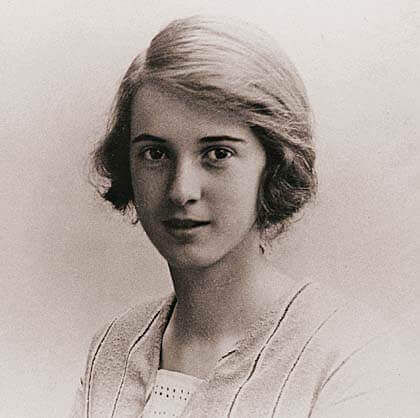
The Wife, 1929
Garwood-Ravilious, Tirzah (1908-1951)

Tirzah Garwood's ‘The Wife’ (1929) is one of the most enigmatic and psychologically compelling engravings of her early career. Although less widely known than ‘Cat into Wife', it is frequently considered alongside that print as part of a sequence exploring women's roles, identity, and marriage during the years immediately preceding her own marriage to Eric Ravilious in 1930.
Unlike Cat into Wife, ‘The Wife’ does not appear to derive from a literary source and is generally regarded as an original conception. It depicts a solitary female figure whose reserved expression and introspective posture suggest quiet reflection rather than domestic fulfilment. Garwood avoids explicit narrative or symbolism, instead inviting viewers to contemplate the emotional and social implications of the title itself.
The engraving was made in 1929, when Garwood was twenty-one and recently engaged to Ravilious. Viewed in this context, the work can be seen as a continuation of her exploration of marriage and female identity begun in earlier works. Rather than presenting "the wife" as an idealised domestic figure, Garwood offers a deliberately ambiguous image that resists straightforward interpretation. The title prompts viewers to consider whether "wife" denotes simply a social role or represents a transformation of personal identity.
Seen alongside Cat into Wife (1928) and Women & Secrets (1928), ‘The Wife’ forms part of a remarkable body of work produced while Garwood was still in her early twenties. Together these engravings demonstrate her ability to use the traditional medium of wood engraving not merely for illustration but to investigate questions of female identity, relationships and social expectation with intelligence, wit and subtle irony.
Garwood-Ravilious, Tirzah (1908-1951)
Eileen ‘Tirzah’ Garwood attended Eastbourne School of Art (1925–28), where she was taught by Eric Ravilious (1903–1942) whom she married in 1930. She first exhibited in 1927, at the Redfern Gallery, and an early woodcut shown at the 1927 Society of Wood Engravers’ exhibition received significant praise in The Times. Such was the originality of her printmaking that she exerted an influence over Ravilious’ own wood engravings. She was also commissioned by the BBC in 1928 to illustrate Granville Bantock’s The Pilgrim’s Progress, and made whimsical but exacting observational pictures that were popular with children and exhibited by the Society for Education in Art. While recovering from emergency mastectomy surgery in 1942 she wrote her autobiography, Long Live Great Bardfield & Love to You All (published posthumously in 2012). After Ravilious’ death that same year, Garwood remained in Essex until her remarriage in 1946. She was again diagnosed with cancer in 1948 and died in 1951. In 1952, a memorial exhibition was held at the Towner Gallery in Eastbourne